Experimental · Biomechanics

Exam Vista Lab

An experimental corner of Exam Vista. The Lab is where we build and test interactive simulations that help students see biomechanics: change a variable, watch what happens, and connect it to the exam answer.

Why a lab?

Biomechanics makes more sense when it moves

Moment of inertia, angular velocity and projectile paths are hard to picture from a diagram on a page. Each Lab experiment lets students control a real movement and watch the numbers, graphs and definitions change in step.

  • Free, with no sign-up, and works in a web browser on a laptop, tablet or phone
  • Built around the topics, wording and graph sketches students meet in A-level PE
  • Useful as a lesson starter, a demonstration on the board or independent revision

Experimental: Lab experiments are works in progress. Models are simplified for teaching and are not validated measurements. Feedback is very welcome through the contact page.

Experiments

Try an experiment

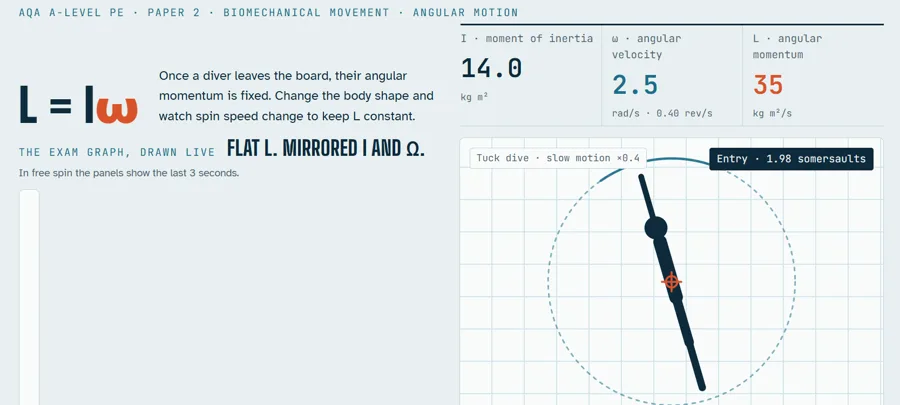
Screenshot of the Angular Momentum Lab: a diver rotating about the centre of mass, with live readouts for moment of inertia, angular velocity and angular momentum
Experiment 01 · A-level PE · Angular motion

Angular Momentum Lab: L = Iω

Run a tuck, pike or straight dive and watch moment of inertia and angular velocity mirror each other while angular momentum stays constant. Includes the live exam graph, AQA definitions and practice questions with mark schemes.

Open the experiment →
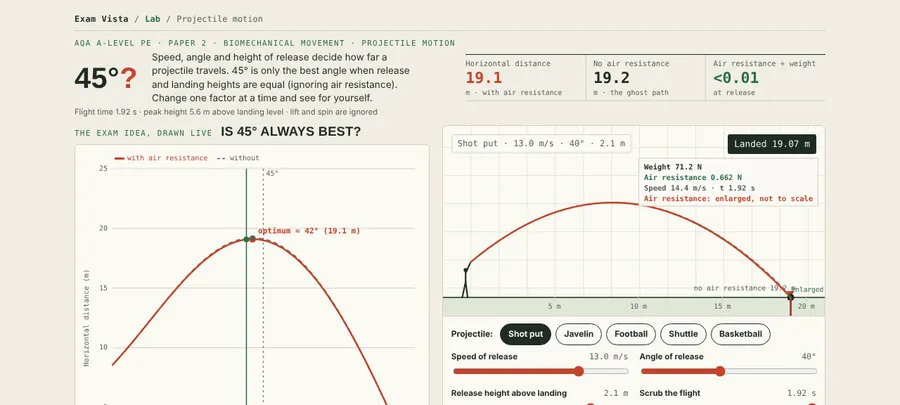
Screenshot of the Projectile Motion Lab: a shot put flight path with live force arrows and a graph of distance against release angle
Experiment 02 · A-level PE · Projectile motion

Projectile Motion Lab

Change speed, angle and height of release and watch the flight path respond. Compare a shot put with a shuttlecock to see parabolic and non-parabolic flight, with live free-body diagrams, a hit-the-target challenge and practice questions.

Open the experiment →
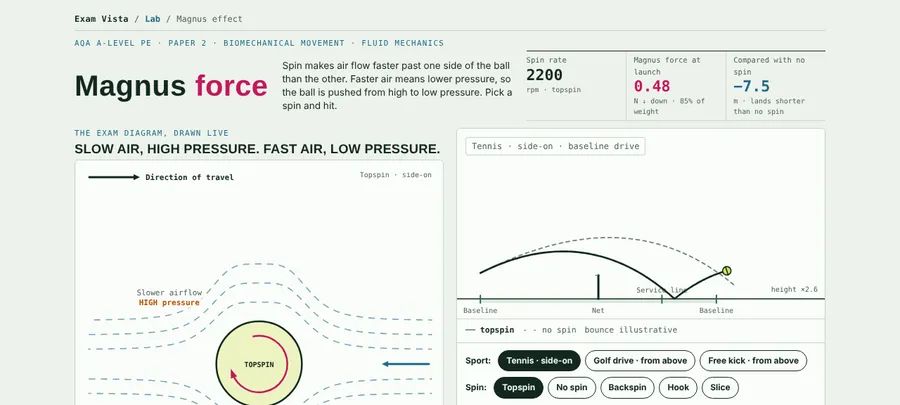
Screenshot of the Magnus Effect Lab: a spinning ball with airflow, high and low pressure and the Magnus force labelled
Experiment 03 · A-level PE · Fluid mechanics

Magnus Effect Lab: spin and swerve

Add topspin, backspin, hook or slice and see the airflow, pressure gradient and Magnus force on the exam diagram as the ball dips, floats or bends. Includes a bend-it free kick challenge and spot-the-mistake diagrams.

Open the experiment →
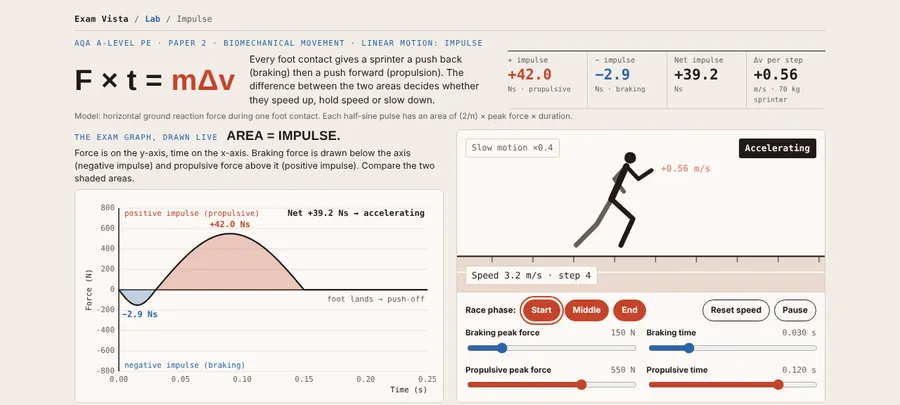
Screenshot of the Impulse Lab: a sprinter force–time graph with positive and negative impulse shaded
Experiment 04 · A-level PE · Linear motion

Impulse Lab: force–time graphs

Build force–time graphs for the start, middle and end of a sprint and see net impulse decide whether the runner speeds up or slows down. Then catch the egg by increasing contact time, and test yourself on naming the graph.

Open the experiment →
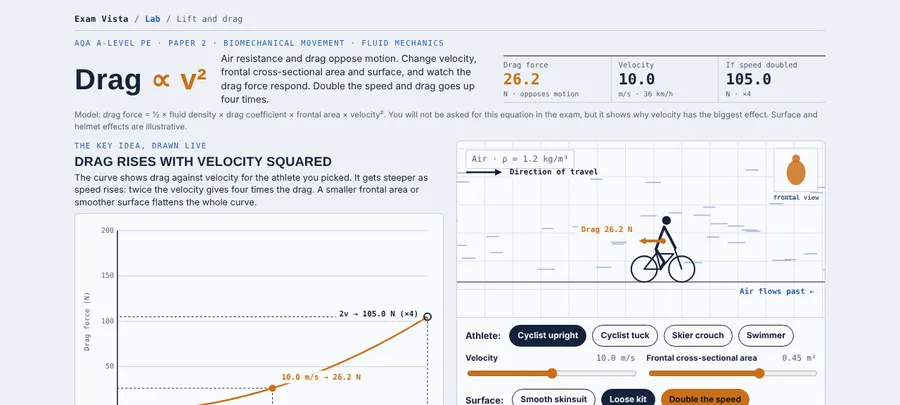
Screenshot of the Lift and Drag Lab: an aerofoil with airflow, high and low pressure, and lift and drag arrows
Experiment 05 · A-level PE · Fluid mechanics

Lift & Drag Lab: air resistance and aerofoils

Put a cyclist, skier or swimmer in the drag tunnel and see how velocity, frontal area, shape and surface change drag. Then tilt a discus or flip a spoiler to see lift and downforce, and race a time trial.

Open the experiment →
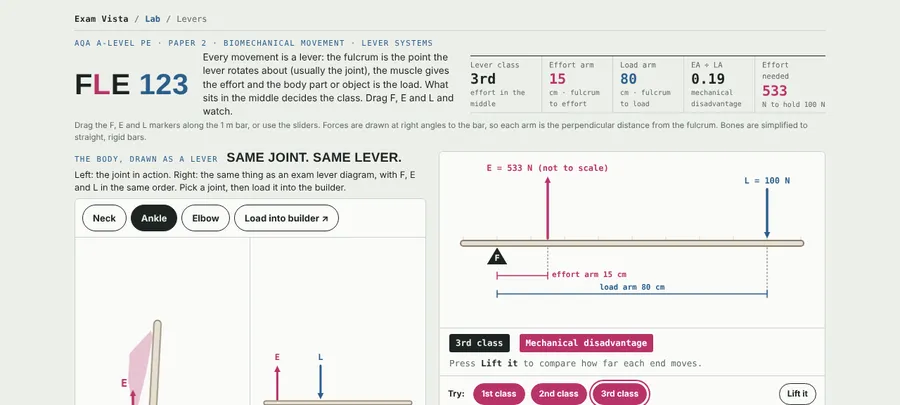
Screenshot of the Lever Lab: a lever with fulcrum, effort and load, and readouts for effort arm, load arm and mechanical advantage
Experiment 06 · A-level PE · Lever systems

Lever Lab: classes and mechanical advantage

Drag the fulcrum, effort and load to build first, second and third class levers, and watch effort arm, load arm and mechanical advantage change. Includes neck, ankle and elbow examples and a name-that-lever quiz.

Open the experiment →
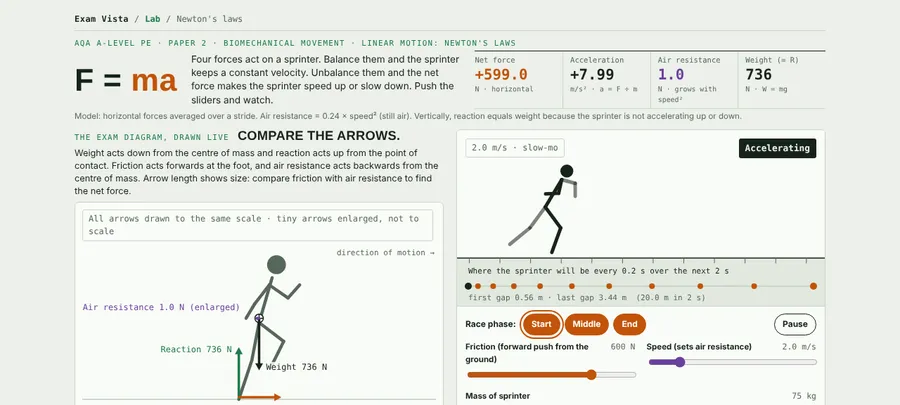
Screenshot of the Newton’s Laws Lab: a sprinter free-body diagram with weight, reaction, friction and air resistance arrows
Experiment 07 · A-level PE · Linear motion

Newton’s Laws Lab: forces and free-body diagrams

See weight, reaction, friction and air resistance act on a sprinter at the start, middle and end of a race, and how net force decides the acceleration. Then fix the free-body diagram, match each scenario to a law and race with F = ma.

Open the experiment →
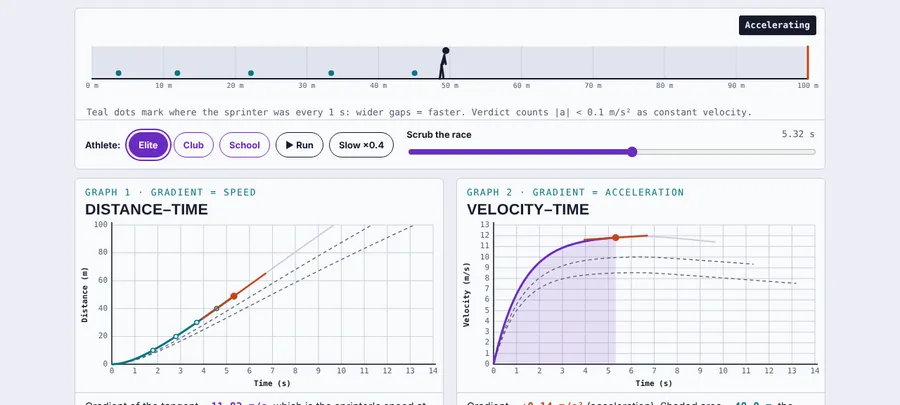
Screenshot of the Motion Graphs Lab: a 100 m sprint with live distance–time and velocity–time graphs
Experiment 08 · A-level PE · Linear motion

Motion Graphs Lab: distance, velocity and acceleration

Replay a 100 m sprint and watch the distance–time and velocity–time graphs draw themselves, with gradients and areas explained. Then predict the graph, plot real split times yourself and sort scalars from vectors.

Open the experiment →
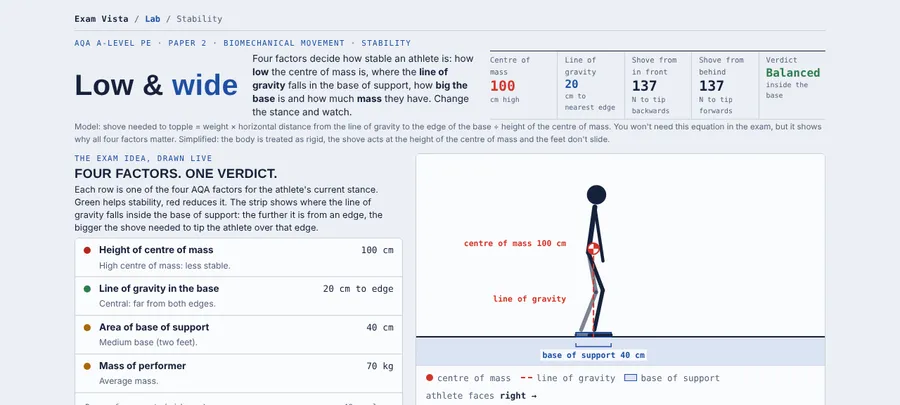
Screenshot of the Stability Lab: an athlete with centre of mass, line of gravity and base of support marked
Experiment 09 · A-level PE · Stability

Stability Lab: centre of mass and balance

Change stance width, crouch, lean and mass and watch the centre of mass, line of gravity and base of support decide whether the athlete stays up. Survive the push test, set up an unstable sprint start and see the Fosbury flop.

Open the experiment →
MOTION LAB · PROTOTYPEDefy
rotation.
Prototype

3D Dive: Defy Rotation

An early 3D test of a somersaulting athlete you can orbit and zoom around. Switch between straight, pike and tuck to compare moment of inertia and spin rate. Uses a placeholder character while a proper diver model is made.

Open the prototype →

More experiments will be added here as they are built.

Want the full topic?

The AQA A Level PE Biomechanics Workbook covers angular motion, momentum, levers, projectiles and fluid mechanics, with worked examples and full answers.

See the workbook